I am often asked how best to behave in the stock markets. Especially in times of Corona, Russia's war against Ukraine, the disruption of supply chains, raw material shortages, staff shortages, energy crisis, of course the consequences of climate change and inflation. My answer: „calm and composed“ and „it depends on what strategy should underlie the capital investment“. For investors who are afraid of increasing losses, it makes sense to invest in very low-risk stocks or to reallocate. The advantage is that you distance yourself to some extent from market dynamics and can possibly sleep much better. The disadvantage is that you distance yourself from market dynamics and thus forgo exploiting market potential.

Among experienced traders, the realization is spreading that especially in times of crisis, short-term investments are on the one hand easier to assess, and on the other hand, performance can be quickly and flexibly adapted to the respective market conditions. However, the „active“ variant requires frequent reallocation of invested money and the search for suitable stocks and their evaluation. But even that is no longer a problem nowadays. With Leeway fundamental analysis, anyone can find suitable stocks for their portfolio with little effort. Here, algorithms take over the evaluation of stocks or companies with artificial intelligence and through the statistical analysis of the price development of recent years as well as the balance sheets of companies – with all their strengths and also weaknesses hidden therein. Thus, only the potentially most stable and promising stocks remain in the shortlist.
It would also be interesting to see how an algorithm supported by artificial intelligence would invest. Like this! For each algorithm, there is a mathematical optimum depending on specifications, such as the risk class. This naturally also applies to Leeway's algorithm. We have compiled this self-selection in the Wikifolio Leeway AI – Quantitativ Global (DE000LS9TLP0) for two years. Successfully: 25% outperformance compared to the DAX shows the added value of the selection mechanisms. This Wikifolio confirms our work in a very impressive way. If we talk about a strategy that is perhaps designed for decades, the crisis should best be sat out.
Ready for Better Investment Decisions?
Start your free trial today - stock analysis with artificial intelligence.
Full Transparency | Full Access | Cancel anytime
Regardless of which point in time you look at it, it has never taken more than ten years for the stock markets to reach new highs. The advantage: You benefit from the long-term upward movement that has been unbroken for a hundred years. The disadvantage: The selection of stocks and the portfolio composition is crucial, because not every company survives every crisis. As insurance for the future, this model is the most popular. ETFs and other funds are designed so that moderate growth can almost be guaranteed over years. Nevertheless, I always recommend Leeway's fundamental analysis, also to avoid nasty surprises.
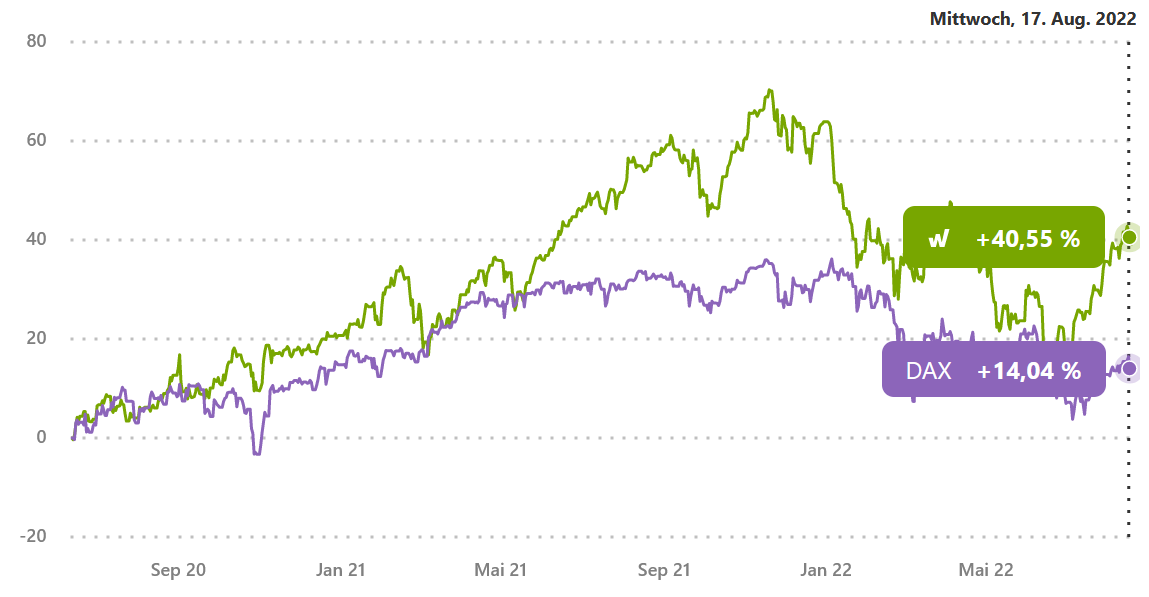
Working professionals with little time can also actively follow market fluctuations with the Stock of the Week. With this strategy, our subscribers are looking at a gain of 38% since the beginning of the year. You don't have to read news or watch the market. The rules are simple: Every weekend we select one stock for the following week – a mixture of Leeway fundamental analysis and technical analysis. It is bought Monday morning and sold Friday evening. Only five minutes a week are enough for implementation. The last two stocks of the week were Rational (+4.7%) and Atlassian (+12.7%). Particularly risky market phases are avoided: The strategy paused in May and June. The situation was too tense and the ratio of opportunity and risk too poor.
Ready for Better Investment Decisions?
Start your free trial today - stock analysis with artificial intelligence.
Full Transparency | Full Access | Cancel anytime
Author: Lars Wißler, Founder and Managing Director of Leeway
Curious? Questions? Exchange? Speak directly with us in the Telegram channel. Simply join!
